
Backyards get designed for how people want to live. Front yards get designed for how the house wants to look, and then Ottawa spends six months a year attacking them.
Everything hard about a front yard here comes from the road being close. Salt spray, plough windrows, snow storage, wind with no shelter, and full winter sun on exposed evergreens. A front yard that only works from May to October is not a finished design in this city, and the failures show up in the third or fourth winter rather than the first.
Start with where the snow goes
Before plants, before stone, answer one question: in February, where is the snow?
There are two piles and they are both predictable. The first is whatever you or your contractor clears off the driveway and walkway, which has to go somewhere within throwing distance. The second is the windrow the City plough leaves across the foot of your driveway, in the same place, every single storm.
Anything living in those two zones is on borrowed time. Snow piled on a shrub bed is heavy, it stays weeks longer than the surrounding ground, and when it goes it takes the salt it collected straight into the root zone. We plan the storage areas first and put beds and specimen plants outside them, which sounds obvious and is skipped almost universally.
The same thinking applies to walkway width. A 900 mm path is a path in July and a trench in January. Front walks here want to be generous enough that clearing them is one pass rather than three.
Salt is a zone, not a yard-wide problem
Road salt does not affect a front yard evenly. It concentrates in a band along the road and along the driveway edge, thrown there by ploughs and traffic, and its effect drops off sharply further in.
That is useful, because it means you do not need a whole yard of bulletproof plants. You need salt-tolerant material in the first few metres and can plant more freely behind that line.
The most common casualty we are asked to replace is cedar hedging planted tight to a road or driveway edge. Cedars brown out on the exposed face, the damage accumulates each winter, and by year four the hedge is bare on one side and nobody understands why. The plant was never wrong; the position was.
Ottawa is Zone 5a on Natural Resources Canada’s plant hardiness map, which is where to start on a plant tag. Exposure then adjusts it. A windswept front bed with no reliable snow cover behaves colder than 5a; a sheltered south-facing foundation strip behaves warmer and will hold things that would not survive twenty feet away.
The boulevard rules people get wrong
The strip between the sidewalk and the curb is City right of way, not your property, and homeowners regularly landscape it without knowing the rules exist.
You can garden there. Ottawa allows residents to plant and maintain a boulevard garden without a permit, provided the Use and Care of Roads By-law is followed. What that by-law sets out:
- Plants, including any raised bed or container height, cannot exceed 1.0 metre
- Inside a corner lot visibility triangle, the limit drops to 0.75 metres
- No trees may be planted in the City-owned boulevard, under the Tree Protection By-law
- No hard materials such as rocks or pavers
- No irrigation systems
- No changing the slope of the land
- No noxious weeds or prohibited invasive species
That “no hard materials” line catches a lot of well-intentioned projects. Homeowners extend an interlock walkway or set decorative boulders into the boulevard, and it is not permitted. Design the hardscape to stop at the property line and let planting carry the last stretch.
Bed lines and walkways do the heavy lifting
Here is the uncomfortable truth about curb appeal: from the road, at 40 km/h, nobody registers your plant selection. They register geometry.
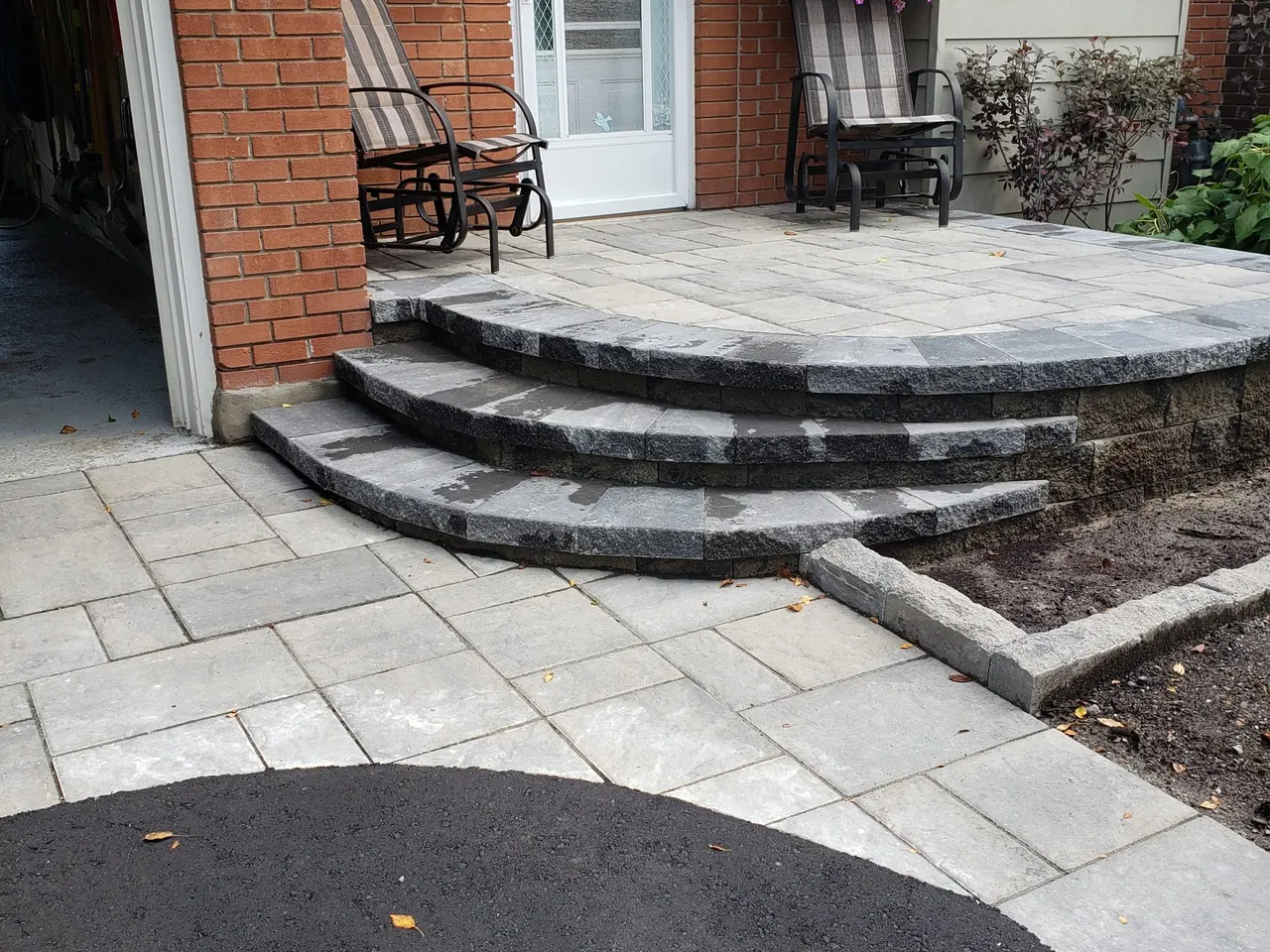
Clean, confident bed lines. A walkway wide enough to look deliberate. A defined front entrance. Edging that holds a crisp line rather than wandering. Those read from the street; individual specimens do not, and they are also the elements that still read in January when the planting is under snow.
This is the argument for spending the hardscape budget on the walkway and the entrance rather than spreading it thin. A proper interlock walkway on a correct base, with a front landing generous enough for two people to stand while a door opens, changes how the whole facade reads. Our patio base depth guide covers why the base matters more than the paver, and it matters more still on a front walk that gets ploughed and salted.
Sod, topsoil, and the part nobody sees
New sod fails for one reason far more than any other, and it is not watering. It is that it was laid on 40 mm of screened topsoil over compacted clay fill, which is standard on many newer Barrhaven, Kanata and Stittsville lots.
Grass rooted into that has nowhere to go in a dry August. It browns first, recovers last, and needs constant water to look average. Depth and quality of topsoil under sod is the whole game, and it is invisible the day the job is finished, which is exactly why it gets cut.
Spring and early fall are the reliable laying windows here. Our Kanata landscaping guide goes deeper on grading, topsoil and lawn establishment, and what landscape construction includes covers how the drainage work underneath connects to all of it.
Grade away from the house, always
A front yard that slopes toward the foundation is a basement problem wearing a landscaping costume.
Before anything decorative goes in, the grade has to move water away from the house. On mature Nepean lots that have settled over decades, and on newer subdivisions where the builder’s rough grade was never refined, re-establishing that fall is frequently the first real task. Sometimes it means excavation and proper backfill rather than a load of topsoil, which we cover in the excavation and backfilling guide.
Get that wrong and the nicest planting plan in the neighbourhood is sitting on a problem.
Sequencing a front yard
The order that works, and it is the reverse of how most projects get imagined:
- Grading and drainage. Where the water goes, decided first.
- Excavation and base. For the walkway, the entrance and any wall.
- Hardscape. Walkway, steps, front landing, edging.
- Soil. Real topsoil depth in the beds and under the lawn.
- Planting. Salt-tolerant at the edges, the good material behind.
- Lighting. Last, and worth doing, because in Ottawa the front of your house is dark for most of the hours you actually see it.
Doing it in this order costs less than doing it in any other order, because nothing gets dug up twice.
Planning yours
We build front yards across Nepean, Kanata, Barrhaven and Stittsville, and the assessment always starts with grade and snow before it gets anywhere near a plant list. Our landscaping service page sets out what a full yard project covers, and the gallery is our own work.
Book a free on-site assessment and we will tell you what your front yard actually needs first.
Published August 24, 2026 by ALM Construction & Landscaping. General information for Ottawa-area homeowners, not a substitute for the City's determination on your specific project.