
Excavation is not something anyone wants for its own sake. It gets booked because something else — a patio that stays flat, a wall that stays vertical, a basement that stays dry — turns out to depend on what is happening below grade.
Here is when it is genuinely needed in Ottawa, and when it is not.
When it is not needed
Worth saying first, because it saves people money.
A great many drainage complaints we are called about are not excavation problems. Water pooling near a foundation is very often a downspout discharging straight against the wall, or a grade that was correct when the house was built and has flattened over thirty years of settling and topsoil. Extending a downspout and re-establishing a slope away from the house are inexpensive corrections that solve a real proportion of the water problems we see.
We would rather establish that on an assessment than sell you a dig you do not need. If a contractor’s first answer to standing water is heavy machinery, get a second opinion.
When it is needed
Base preparation that goes beyond a patio. A garden walkway needs a modest excavation. A driveway carrying vehicle loads, or a patio on a lot where the fill is still consolidating, needs considerably more. On the newer subdivisions across Kanata, Barrhaven and Stittsville, thin topsoil over compacted clay fill is common — and clay holds water like a bathtub. Getting a durable surface over that means excavating deeper and building a base that drains, because the soil will not do it.
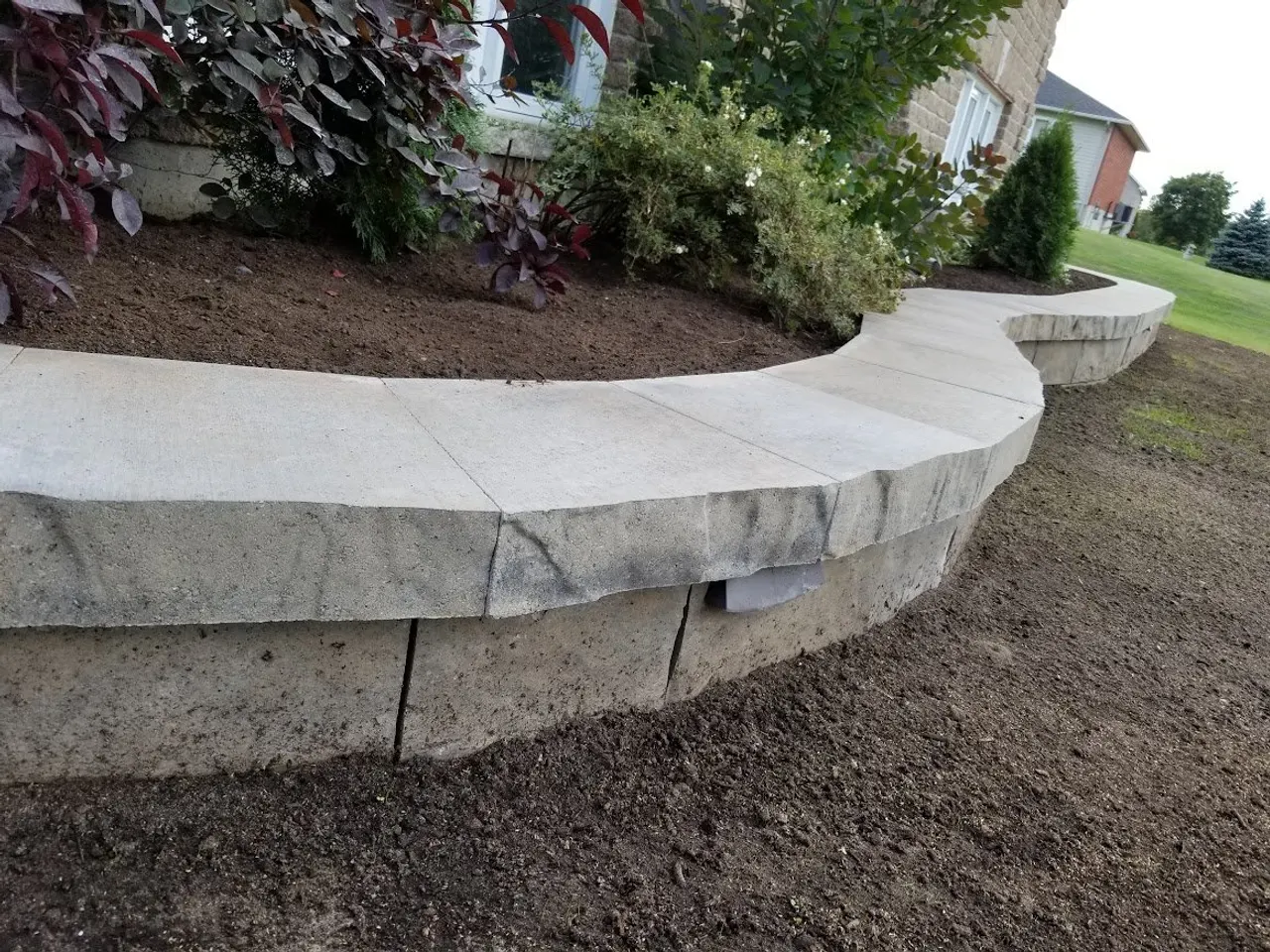
Retaining walls. A retaining wall is mostly an excavation and drainage project with a stone face on the front. What holds a wall up is the footing it bears on, the granular backfill behind it and the drain that takes water away. The visible stone is the last and least structurally interesting part. Walls that lean or bulge within a few years almost always failed behind, not in front.
Grade changes. Making a sloped yard usable — cutting a terrace, levelling for a pool surround — moves real volumes of material, and where that material goes matters as much as where it came from.
Below-grade water. When water is getting into a basement rather than merely pooling outside, and grading and downspouts have been ruled out, the answer may be exposing the foundation to address waterproofing or a weeping tile that has silted up. That is a serious job and worth being certain about before committing.
Locates come first
Before any digging in Ontario, underground utility locates must be requested through Ontario One Call. This is a legal requirement, it is free for homeowners, and it takes several business days to come back.
That waiting period is a scheduling reality worth knowing when a contractor promises to start Monday. Striking a gas line is a genuinely dangerous event, and striking a hydro or communications line is an expensive one. Locates are not paperwork; they are the reason the job does not make the news.
The backfill question
What goes back into the hole matters as much as what came out, and this is where corners get cut invisibly.
The temptation is to backfill with the material that was excavated, because it is already on site and disposing of it costs money. Where that material is clay, putting it back against a foundation or behind a retaining wall places a water-retaining material exactly where water pressure does the most damage. Through Ottawa’s freeze-thaw cycle, water that cannot drain freezes, expands and pushes against whatever is holding it.
Free-draining granular backfill, with a drain at the base taking water somewhere sensible, is what stops that. It costs more, because the material has to be brought in and the clay has to be taken away.
If you are comparing quotes on a wall or a foundation job, backfill material is one of the lines worth asking about directly. It is the sort of thing that does not appear on a one-page quote at all.
Compaction
Material replaced in a deep excavation has to be compacted in lifts — layers, each compacted before the next goes on — rather than dumped and rolled once at the top. A hole filled in one pass will consolidate over the following years, and everything built on it will follow it down.
This is slow, unglamorous work and it is most of what separates a surface that stays flat from one that does not.
What to ask a contractor
Three questions, and they are all answerable on the spot by someone who does this properly:
Have locates been requested, and when do they come back? What is going back into the hole, and where is the water going? And how is the backfill being compacted?
Since March 1, 2026 the City of Ottawa has also required hardscaping contractors to hold a municipal business licence. Ask to see it.
Getting an assessment
We assess before we quote, and a fair proportion of the time the assessment concludes that the problem is a downspout and a grade rather than a dig. Where excavation genuinely is the answer, we write the depth, the backfill material and the drainage detail into the scope so you can see what you are buying.
The full service is on our hardscaping page. Our piece on patio base depth and Ottawa’s freeze-thaw cycle explains why depth matters so much here, and permits for retaining walls and pool decks covers the approvals side. Where the grade problem ends in a wall, what makes retaining walls last explains the drainage detailing that decides whether it stands. For what the ground is like suburb by suburb, from Nepean’s settled foundation backfill to Kanata North’s shallow rock, see excavation and backfilling in Kanata, Stittsville and Nepean.
Book a free on-site assessment and we will tell you honestly whether you need excavation or a downspout extension.
Published August 9, 2026 by ALM Construction & Landscaping. General information for Ottawa-area homeowners, not a substitute for the City's determination on your specific project.