
Barrhaven has grown faster than almost anywhere in Ottawa. What began as Mel Barr’s subdivision in the 1960s had 103,234 residents at the 2021 census, and much of it is recent: construction in Stonebridge began in 2000, and in Half Moon Bay in 2007, where the population nearly doubled between 2016 and 2021.
That history shapes almost every landscaping project in Barrhaven. Most yards here were finished by a builder, graded to an engineered plan and handed over with sod and not much else. The lot is small, the only way in is a side gate, and the grading under the lawn is a City matter rather than a design preference. Here is how a Barrhaven yard gets landscaped properly, in the order the work has to happen.
Start with the grading plan, not the plant list
Every subdivision lot is graded to an approved plan that moves water away from the houses and off the property, usually through a shallow swale along the rear or side lot line that several neighbours share.
The City is blunt about what that means. Its Landscaping Education Guide, published in March 2026, says: “You are not allowed to change the grading of a property.” The City’s lot grading guidance adds that swales are not to be filled, piped or obstructed by landscaping features such as sheds or gardens, and that work which undermines a lot’s intended drainage breaches the Site Alteration By-law.
In practice that rules out the three most common Barrhaven mistakes:
- A raised bed along the back fence, sitting right in the swale.
- A shed on the low corner of the yard, because it looked like the only flat spot.
- Topsoil or a patio that lifts the yard until water runs toward the house or next door.
None of that means the yard cannot change. Beds, patios and planting can all be laid out so the water still leaves the way the plan intends. And where a builder’s grade has settled or never worked, the job is restoring the plan, not inventing a new one. If you want to see your lot’s plan, the guide says to request it through the City’s access to building permit records service, or call 3-1-1 if none exists. We look at it before we draw anything.
Small lots, one gate
Barrhaven lots are tight and the side yards are tighter. Every machine and every load of soil, stone and mulch comes in through the gate, so access is part of the design from the first visit rather than a problem discovered on install morning. A compact excavator can work through a narrow side yard. A design that quietly assumes a skid steer cannot.
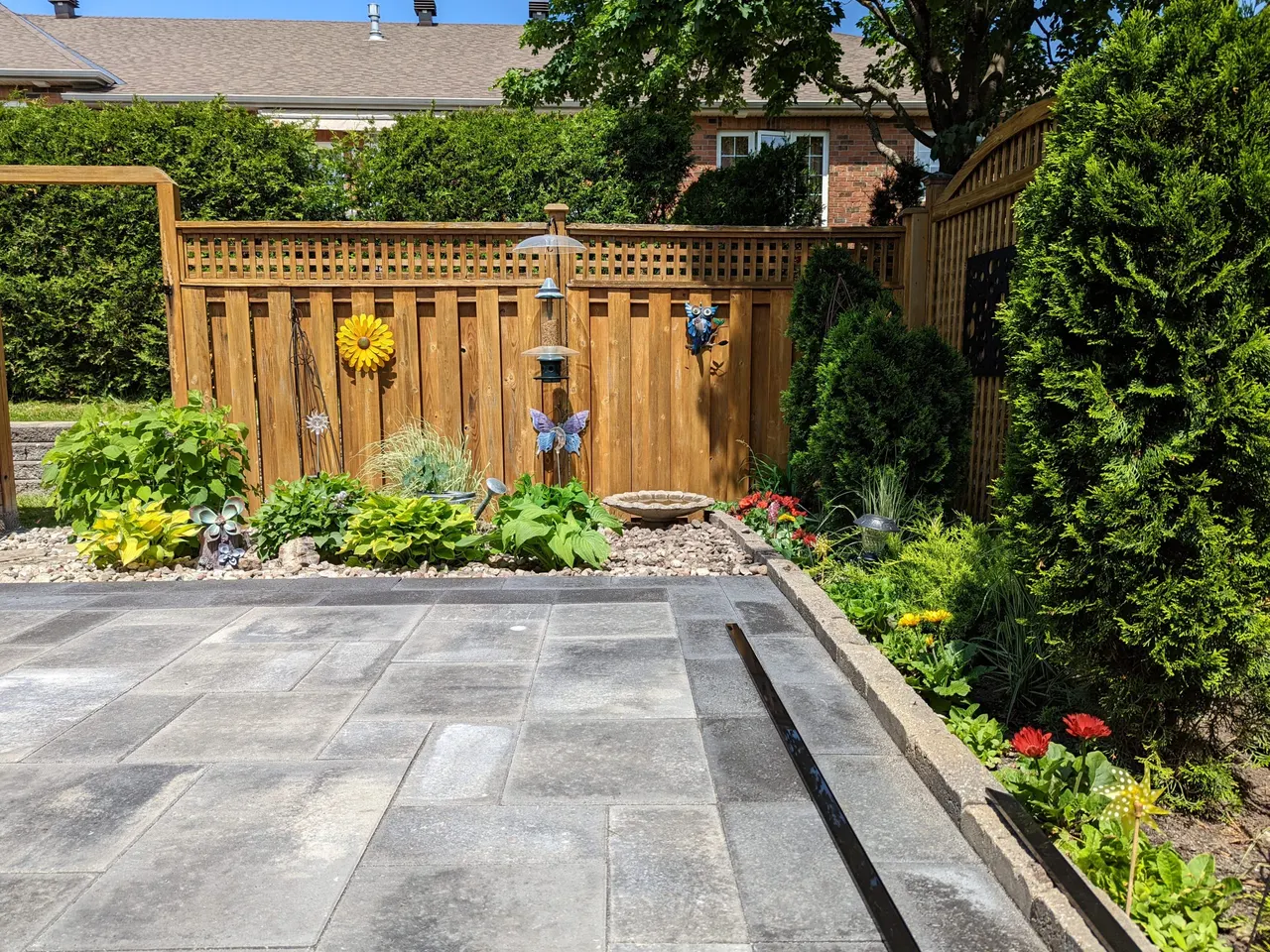
A small lot also changes what the landscaping is for. Without room for a big lawn, the yard has to do several jobs in one footprint:
- A patio sized to real furniture, not to whatever is left over. Our guide to designing an Ottawa backyard explains how to size it.
- Privacy planting along the fence line. With houses on three sides, screening is often worth more than any other feature in the yard.
- A small lawn built properly instead of a large one that is never healthy.
- Somewhere for bins, bikes and a shed that is not in the swale.
The soil under the sod
New Barrhaven yards share a problem with the rest of Ottawa’s recent subdivisions: a thin layer of topsoil over compacted clay fill. Grass and shrubs root into the top few centimetres and stop, which produces a lawn that is soggy in April and brown by July, and shrubs sitting in water every spring.
We covered the fix in full in softscaping in Stittsville and Barrhaven: break up the compaction, amend the soil and give the lawn real topsoil depth before anything is planted. On a Barrhaven lot there is one extra constraint. Because the finished grades are set by the plan, more depth usually means removing poor material and replacing it, not piling new soil on top. It is typically the biggest line in a good Barrhaven landscaping budget and the one nobody sees afterwards.
Trees: plant for the size in forty years
A new subdivision has almost no shade, and a tree is the most valuable thing you can plant. It is also the one to place most carefully.
The City identifies shrinkage of sensitive marine clay as a major contributor to foundation damage in the Ottawa area. Where those soils are known, its 2017 guidelines for City-owned trees call for low-water-demand species planted at a distance equal to the tree’s full mature height from a foundation, with shorter setbacks only when specific engineering conditions are met. Those guidelines govern street trees, not your backyard, but on a lot where the house is never far away they are a sensible benchmark. Put small ornamental trees near the house, and large shade trees only where their mature size fits well away from it.
On older Barrhaven streets the issue is the reverse: protecting trees that are already there. Under the City’s Tree Protection By-law, a distinctive tree, 30 cm or more in diameter at breast height on an urban private property of 1 hectare or less, needs a permit to remove. The Landscaping Education Guide also sets a critical root zone of 10 cm of radius for every 1 cm of trunk diameter, so a 30 cm tree has a 3 m zone. You cannot dig inside it without approval from Forestry Services, and protection fencing at least 1.2 m high has to go up before work starts. That includes a neighbour’s tree whose roots cross your lot line.
Front yards: part of it belongs to the City
The front of most Barrhaven lots includes City right of way between the property line and the curb or sidewalk, and the guide is specific about it:
- The only hard landscaping allowed in the right of way is a driveway and walkway, and together they cannot take up more than 50 per cent of the property’s frontage.
- River rock, stones, boulders and raised decorative features are not allowed there.
- One walkway up to 1.8 m wide can be added without a permit if it meets a list of conditions, including staying outside any tree’s critical root zone and ending at the sidewalk.
- Widening a driveway by more than 1.8 m needs an access permit and a road cut permit.
Boulevard gardens have their own height and material limits, which we set out in front yard landscaping in Ottawa along with the road salt and plough windrows that decide what survives at the curb.
Plan the fence with the landscaping
Most Barrhaven yards get a fence before or during landscaping, and the two should be planned together so post footings, bed lines and lighting runs are not fighting each other. The City’s guide sets residential fence heights at up to 2.1 m in back and side yards and 1 m in front yards, with gates allowed 30 cm taller. A standard fence needs no permit. A fence that encloses a pool, hot tub or pond holding more than 60 cm of water needs a pool enclosure permit.
Every fence post is also a hole. Provincial law requires a utility locate before you dig, even with a hand shovel, through Ontario One Call at 1-800-400-2255.
Backing onto the Jock River
Stonebridge and Half Moon Bay both border the Jock River. Land near a river can fall inside an area regulated by a conservation authority, which on the Jock is the Rideau Valley Conservation Authority, and the City’s guide notes that a pool in a conservation-regulated area or flood plain needs the authority’s approval. If your yard backs onto the river corridor, check before planning grading work, a pool or a large structure.
The order it goes in
- Grading plan review and any drainage correction needed to restore it.
- Fence, with locates done and footings placed.
- Hardscape: patio, walkway, edging, any low walls.
- Soil: remove poor fill, amend, and bring topsoil back to the planned grades.
- Trees and structural planting, then the beds.
- Sod last, in late April to early June or late August to October.
- Mulch and lighting fixtures.
Getting that order wrong is how a yard gets paid for twice. Our guide to whether hardscape or softscape comes first explains why, and how to split the budget between them.
Landscaping your Barrhaven yard
We design and build yards across Barrhaven, from Stonebridge and Half Moon Bay to Longfields and Chapman Mills. The scope covers grading and drainage, soil, sod, beds, planting, trees and low-voltage lighting, plus the patios and walkways that go with them. You can see the full service on our landscape construction page, the local detail on our Barrhaven landscaping page, and the stone side on our Barrhaven hardscaping page. Renovating inside as well? Do that first, and see home renovations in Barrhaven for what the same houses need indoors.
Book a free on-site estimate. We will look at your grading plan and where the water actually goes before we talk about what to plant, then send a written, fixed-price scope.
Published September 13, 2026 by ALM Construction & Landscaping. General information for Ottawa-area homeowners, not a substitute for the City's determination on your specific project.