
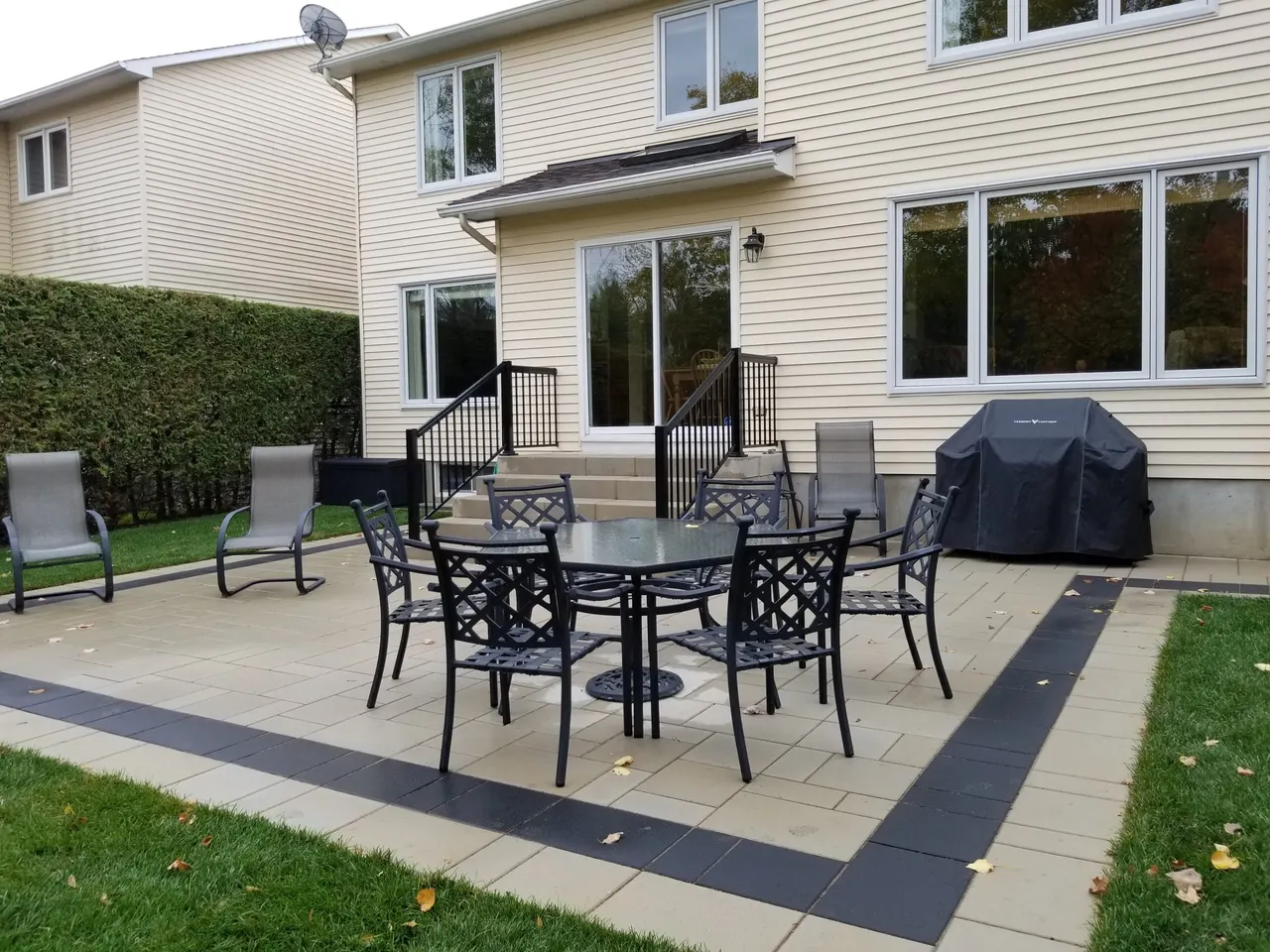
Landscaping gets talked about as though it is the fun part at the end — the plants, the beds, the finished lawn. On the Kanata properties we work, it is mostly a drainage and grading job with planting on top. The yards that fail almost never fail because the wrong shrub was chosen. They fail because water goes somewhere it should not, and the plants take the blame.
Here is what landscaping in Kanata actually involves, and the order it has to happen in.
What landscaping covers
Landscaping is the living and shaped side of a property: grading, drainage, topsoil, sod and seeding, garden beds, planting, edging and lawn establishment. It is distinct from hardscaping, which is the built hard-surface side — patios, walkways and walls. Most full yard projects involve both, and the hardscape typically goes in first because the softscape gets arranged around it. The full scope is on our landscaping service page, and the local version on our Kanata landscaping page.
Grading comes before everything
The single most useful thing to understand about a yard is that it is a water management system before it is a decorative one. Every lot is graded when it is built so that surface water moves away from the foundation. Over time that grade drifts. Soil settles, homeowners build beds up against the house, downspouts get moved or extended, fences and sheds interrupt flow paths, and a neighbour’s new patio redirects water onto your side.
In Kanata this plays out differently depending on the age of the property. On the older Beaverbrook-era lots, decades of accumulated changes have quietly moved the grade. In the newer subdivisions, engineered fill is still settling, and it settles unevenly, which means the original grade is actively changing underneath a lawn that looks fine on the surface.
Either way, if water pools against the foundation or sits in the middle of the lawn after every rain, no amount of planting fixes it. Regrading to re-establish positive slope away from the house is the first work, and sometimes surface grading alone is not enough and subsurface drainage has to carry water the grade cannot.
Topsoil is not a formality
The layer plants actually live in gets skipped or shorted more than any other part of a landscaping job, because once sod is rolled over it nobody can see what is underneath.
New subdivision lots are notorious for a thin skim of topsoil over compacted construction subgrade. Grass will germinate in it and look acceptable for one season, then struggle every year after because the roots have nowhere to go and the compacted layer beneath holds water like a bathtub. Establishing genuine depth of quality topsoil, and breaking up the compaction under it, is what separates a lawn that thrives from one that is permanently on life support.
Sod, seed and lawn establishment
Sod gives you an instant lawn and holds a slope immediately, which matters on graded ground where seed would wash. Seed costs less and offers more variety choice but takes a season to establish and needs consistent moisture through germination.
Spring and early fall are the more forgiving windows in Ottawa, since cooler temperatures and more reliable rainfall let roots establish before heat stress. Mid-summer installation is possible but unforgiving about watering. Whichever route you go, the establishment period is where most new lawns are won or lost, and it is almost entirely a watering discipline question.
Planting that survives an Ottawa winter
Kanata sits in a climate that swings hard. Plant selection has to account for winter hardiness, but also for the things that quietly kill suburban plantings: road and walkway salt near driveways and entries, wind exposure on open newer lots that have no mature tree canopy yet, and deep snow load from roof shedding.
Newer subdivisions have a particular challenge in that there is no established shade, so plantings that would thrive under mature Beaverbrook canopy will cook in an open backyard. Choosing for the conditions you actually have, rather than the ones the yard will have in twenty years, is the practical approach.
Beds also need real edging and a defined boundary against lawn, or they migrate. Mulch depth matters for moisture retention and weed suppression, and mulch piled against stems and trunks causes rot rather than protection.
How a full yard project sequences
For a complete Kanata yard build the order is consistent: grading and drainage first, then any hardscape structure — patio, walkway, walls — then topsoil, then beds and planting, then sod last so it is not driven over by everything that follows. Doing it out of order means redoing parts of it.
If your project includes hard surfaces, our Kanata hardscaping guide covers that side, and what landscape construction includes explains how the two fit together on a single project. For the order and the budget split between the two, see hardscape or softscape first; for the street side of the property, front yard landscaping in Ottawa.
Planning a yard in Kanata?
How a Kanata yard gets designed before it gets built, and why the grading plan comes first, is in landscape design in Stittsville and Kanata. The soil and planting side is covered in softscaping in Stittsville and Barrhaven. If the inside of the house is on the list too, home renovations in Kanata covers what each era of Kanata house needs.
We work the Kanata area on a regular weekly rotation. Tell us what you are picturing and we will come walk the lot, tell you honestly where the water is going, and send a written, fixed-price scope. Book a free on-site estimate and we will measure and price it for you.
Published July 26, 2026 by ALM Construction & Landscaping. General information for Ottawa-area homeowners, not a substitute for the City's determination on your specific project.