
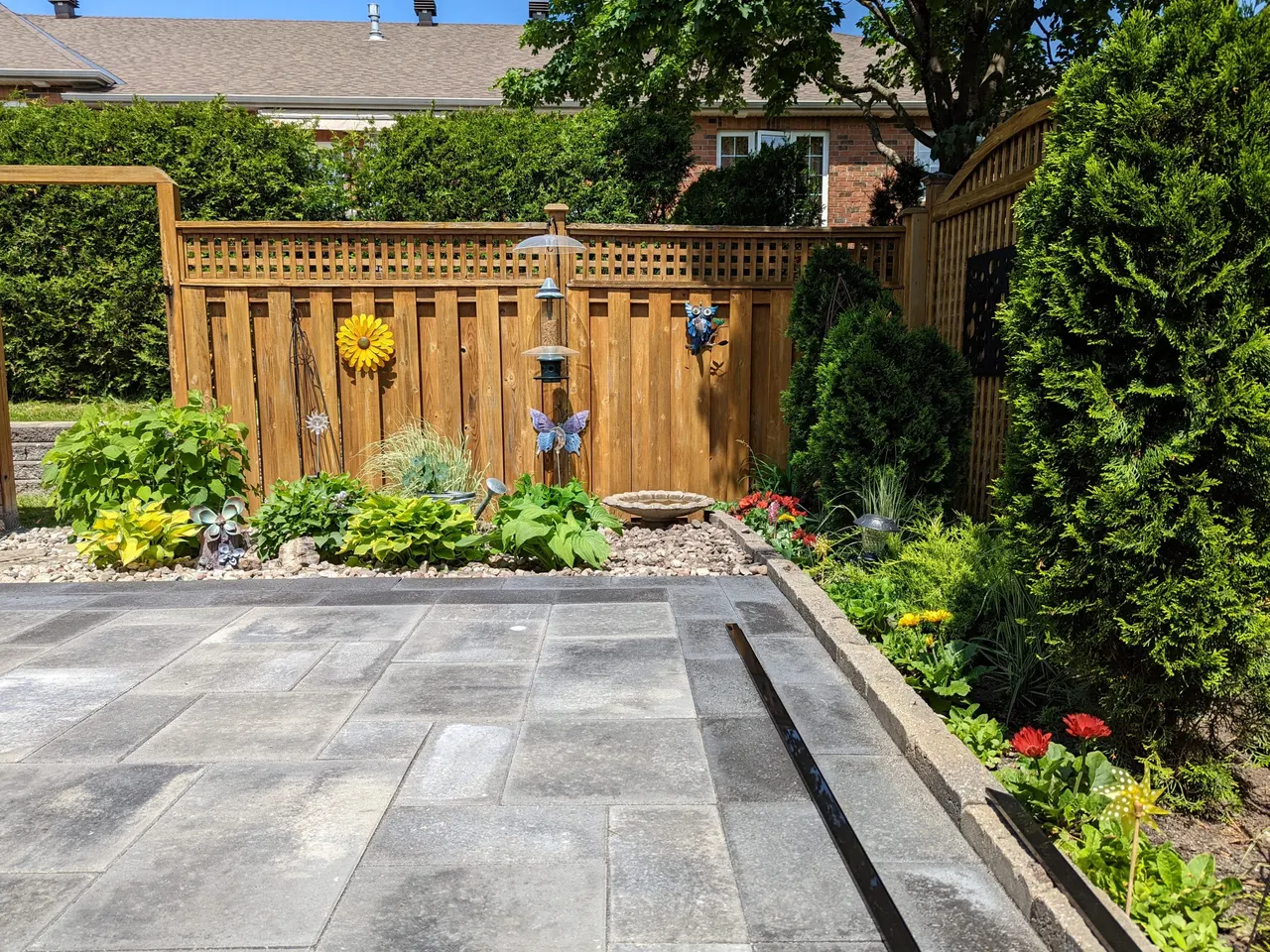
A garden bed or a new tree is the one part of a yard that should look better in year five than on the day it went in. Too often it looks worse. In Kanata, Barrhaven and Stittsville, the failures we are called to fix are nearly always the same: a plant chosen for the garden-centre display instead of the actual spot, a tree buried too deep, a bed dug into builder clay, and mulch piled up against trunks.
This guide covers how we install garden beds, plant trees and mulch so they last, along with the City of Ottawa rules that decide where things can go.
Start with what the lot gives you
Every plant decision starts with three facts about the spot: how much sun it gets, how wet the soil stays, and how cold it gets. Ottawa is Zone 5a on Natural Resources Canada’s plant hardiness map, and the tag on a big-box plant is often written for a warmer market. Exposure then shifts that. A windswept front bed with no reliable snow cover behaves colder than 5a, while a sheltered south-facing corner behaves warmer.
The three communities start from different places:
- Barrhaven is usually a first install. The builder leaves the lot graded and seeded, and everything beyond that, including beds, trees and lighting, is up to the homeowner. Lots are compact, so a bed has to work hard: screening, colour and a clean edge against the lawn in the same strip.
- Kanata splits by age. In Beaverbrook and the older parts of Katimavik, mature trees and hedges already own the yard, and the new planting has to fit around their roots. In Kanata North, near the Carp Hills, bedrock can sit much closer to the surface than a design assumes, so a tree pit may not reach the depth the tree needs. Raised beds and careful species choice solve that. We dig test holes first.
- Stittsville lots tend to be larger, with room for real shade trees, layered beds and screening along the back line. The challenge is scale: planting has to read from across the yard, and the low end of a big lot often stays wet into June.
Choosing plants that last
The City’s Landscaping Education Guide strongly encourages native plants from Eastern Ontario, because they are suited to local climate, soil and pests and they support pollinators. Its examples include bearberry, wintergreen, blue flag, asters, Canada anemone, trilliums and Canada yew.
Two rules sit alongside that. You may not plant noxious weeds, and the Province regulates invasive species that cannot be planted and that owners must remove. And because Ontario bans the sale and use of cosmetic pesticides, a bed here has to be healthy and dense enough to crowd weeds out on its own. That is the strongest practical argument for the right plant in the right place.
We design beds around exposure, soil and how much maintenance you actually want to do. A full-sun Barrhaven front bed and a shaded Beaverbrook backyard need almost nothing in common.
How we install a garden bed
A bed that thrives is mostly preparation. The planting itself is the quick part.
- Lay out the shape on site with paint or a hose, at a size you will actually maintain. Curves should be wide enough to mow around in one pass.
- Call in locates. Provincial law requires a utility locate through Ontario One Call before digging, and Hydro Ottawa advises not digging within one metre of marked lines.
- Strip the turf and remove it, rather than burying it under soil.
- Loosen and amend the soil. Builder clay is broken up and organic matter worked in so water and roots can move down. Our softscaping guide goes deeper on building soil that drains.
- Respect the grade. The City’s guide is clear that planting must not alter grading and drainage patterns. Beds along the foundation are built so the ground still slopes away from the house, not up against the siding.
- Install edging so the lawn stays out of the bed and the mulch stays in it.
- Plant, water in, then mulch.
Tree planting: where it can go
Before choosing the tree, choose the spot. The City’s guide sets out the rules plainly:
- At least 3 m from building foundations, with 1.5 m of open space around the trunk so water and nutrients reach the roots. Do not pave up to a tree.
- Not in the City’s right of way. The strip between your sidewalk and the road belongs to the City, and trees and hedges cannot be planted there.
- Away from utility areas. Hydro Ottawa’s safe distance of 3 m from overhead lines applies to tree branches as well as people, so check the mature height and spread on the tag before planting under or near a line. Keep the front of any pad-mounted transformer clear.
The same guide gives a useful rule for placement: evergreens on the north or west side of the house to block winter wind, and leafy trees on the south and west sides for summer shade with winter sun. It also notes that well-placed trees can cut home energy costs by 10 to 50 per cent.
Tree planting: how it goes in
Most young trees that die in their first years were planted too deep. The root flare, where the trunk widens into the roots, has to stay visible at the surface. Buried, the trunk stays wet, the bark breaks down, and roots start circling instead of spreading.
Municipal planting guidance such as the City of Calgary’s sets out the method we follow:
- Dig wide, not deep. The hole can be up to three times the width of the root ball, but no deeper than the root ball itself, so the tree does not settle below grade.
- Find the flare and set it partly visible above finished grade.
- Cut away string and wire from around the trunk and the top third of the root ball on burlapped trees.
- Backfill in stages, firming each layer and settling it with water so there are no air pockets.
- Water at least once a week through the first season, more in heat.
- Stake only if needed, using two stakes and wide, flexible ties, and remove the stakes after the first year. A tree held rigid grows a weaker trunk.
On Kanata North rock, or wherever a test hole hits bedrock or a hard layer, we change the plan rather than force the tree in: a smaller-maturing species, a raised planting area, or a different spot.
Mulching done properly
Mulch is the most-searched part of this work in Stittsville, and the easiest part to get wrong.
Depth. About 5 to 10 cm (two to four inches) over prepared, weeded soil, which is the range Calgary’s planting guidance gives. Less does not suppress weeds or hold moisture. More starves the roots of air.
Keep it off trunks, stems and the foundation. Mulch piled against bark holds moisture against it and rots it. The “mulch volcano” heaped around a young tree is one of the most common ways new trees are damaged. Leave a clear ring at the base, and keep mulch back from the house as well.
Top up instead of piling on. Organic mulch breaks down over two or three seasons. Rake it out and top it up to the same depth, rather than adding a fresh layer every May until the bed becomes a mound.
Organic or stone. Shredded bark and natural cedar mulch break down into the soil and improve it. River rock does not break down and does not feed the soil, but it suits drainage strips, dry corners and areas against the foundation. Many yards use both, as in the photo above.
How much to order. Multiply the bed area by the depth. A 20 m² bed at 7.5 cm needs 20 × 0.075 = 1.5 m³, which is about 26 of the common 2-cubic-foot bags. Past a few cubic metres, bulk delivery makes more sense than bags.
Mulched beds count toward your front yard’s soft landscaping. The City requires that at least 50 per cent of a front yard be soft landscaping, which includes plants, soil, lawn and mulch. Artificial turf does not count.
Protecting the trees you already have
New planting often happens near trees that are already worth a great deal. Under the City’s Tree Protection By-law, a private tree of 30 cm or more in diameter on an urban lot of one hectare or less needs a permit to remove. The critical root zone is 10 cm of radius for every 1 cm of trunk diameter, so a 30 cm tree has a 3 m zone. You cannot dig inside it without approval from Forestry Services, and protection fencing at least 1.2 m high goes up before work starts. That includes your neighbour’s tree if its roots cross the fence.
On mature Kanata and Stittsville lots, this decides where new beds can be cut and how deep they can go. Planting a new bed over a mature tree’s roots usually means working by hand and keeping the soil level close to what is already there.
Aftercare, and our warranty
The first season decides everything. New beds and trees need regular, deep watering until they root, then less frequent watering so the roots follow the water down. We hand over a written aftercare guide with every planting, and trees, shrubs and perennials we install carry a one-year replacement warranty when that guide is followed.
We are a design-and-build crew, not a maintenance company. We will set up the beds so they are easy to look after, and we can recommend Ottawa crews for ongoing weeding and pruning.
Garden installation in Kanata, Barrhaven and Stittsville
We design and install garden beds, trees, shrubs, mulch and edging across Kanata, Barrhaven and Stittsville, either on their own or as part of a full yard. The full scope is on our landscape construction page. If the lawn needs replacing too, see sod installation in Stittsville and Barrhaven, and for planning the whole yard, read backyard landscaping in Kanata and Barrhaven and landscaping in Kanata.
Book a free on-site estimate. We will look at your light, your soil and the trees already on the lot, and send a written, fixed-price planting plan.
Published October 18, 2026 by ALM Construction & Landscaping. General information for Ottawa-area homeowners, not a substitute for the City's determination on your specific project.