
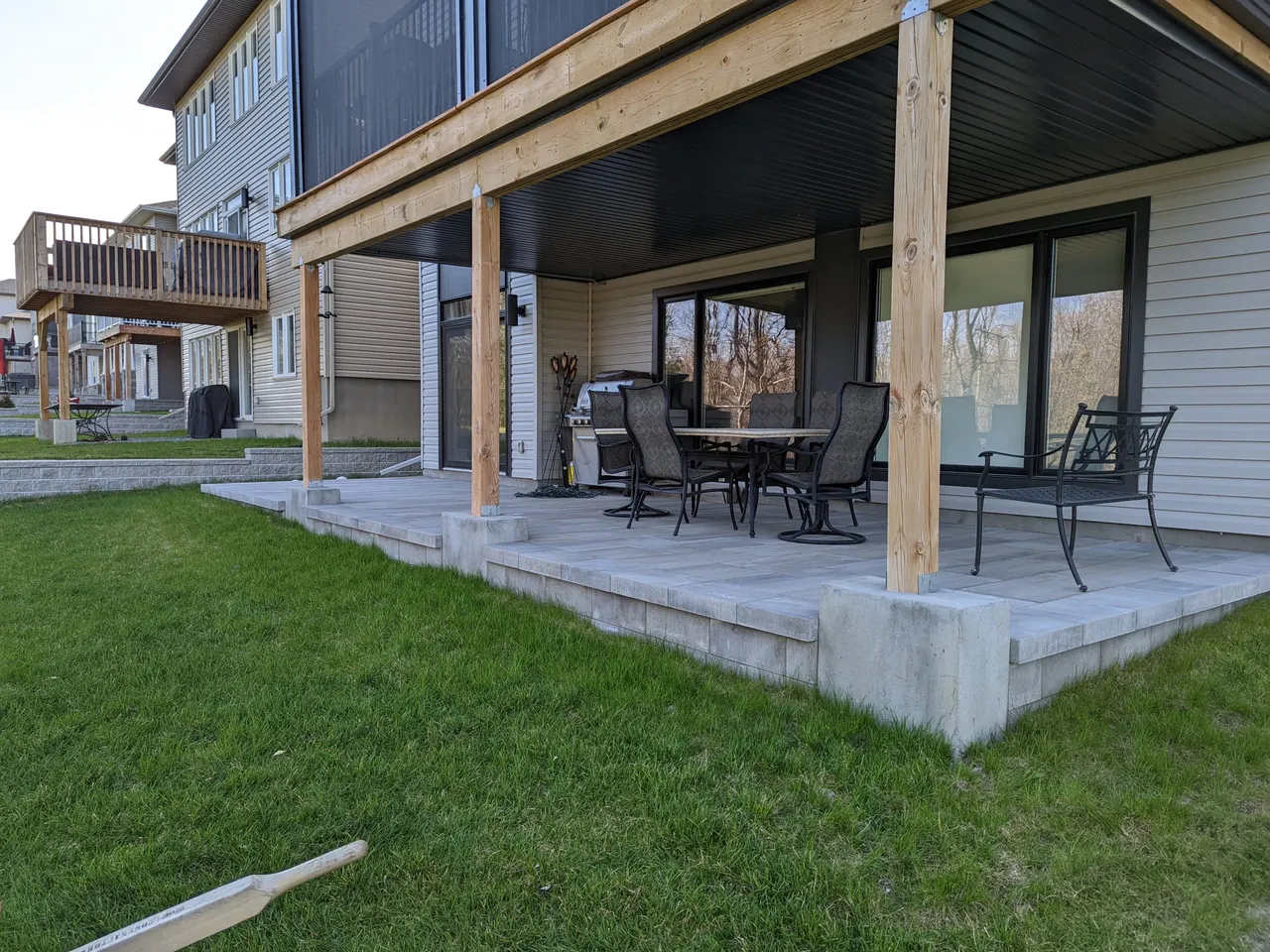
People search for excavation in Kanata or backfilling in Nepean because a project they actually want depends on it: a patio that stays level, a basement that stays dry, a retaining wall that stays upright. What that project needs underground depends on where the house is. The three suburbs we work in most sit on quite different ground.
Our general guide to excavation and backfilling in Ottawa covers when a dig is needed at all. This one goes suburb by suburb.
What applies everywhere
A few rules hold across the whole city, and a contractor who skips them is telling you something.
Locates first. Provincial law requires you to locate underground utilities before you dig, even with a hand shovel. Requests go through Ontario One Call, are free, and need at least five business days’ notice for a single property. Any start date sooner than that is a start date without locates.
Grading is not yours to change. The City’s Landscaping Education Guide is blunt: you are not allowed to change the grading of a property. Grades are designed to direct water away from the home, and all projects must follow the approved drainage patterns. Water cannot be sent onto a neighbour’s lot unless the approved plan does so. If a grading plan exists for your property, the City will provide a copy through its building permit records service. Excavation that ends with a different grade than it started with needs to end with the right one.
Permits for some digs. Excavation in the City’s right of way needs a road cut permit. Excavation to replace a service, such as a sewer or water connection, needs a building permit.
Conservation authorities. If a property is in a regulated area, such as near a creek, wetland or floodplain, approval from the conservation authority is needed before work starts. In the west end that is the Mississippi Valley Conservation Authority on the Carp River side of Kanata and Stittsville, and the Rideau Valley Conservation Authority for most of Nepean.
Backfill that drains, compacted in lifts. Whatever comes out of the hole, what goes back against a wall or under a surface should be free-draining granular, placed in layers and compacted as it goes. Clay put back where it came from holds water, freezes, and settles for years.
Nepean: mature lots, old backfill and big trees
Much of Nepean was built between the 1950s and the 1980s. That gives it the two things that shape almost every excavation we do there: foundations that have been backfilled for fifty years or more, and trees that have been growing for just as long.
Settled foundation backfill. When these houses went up, the trench around the foundation was often backfilled with whatever came out of it, and it has been consolidating ever since. The result is a low strip along the house, sometimes only a few centimetres, that reverses the slope and sends roof and surface water toward the basement wall. It is the single most common thing we find under a sunken walkway or a patio that has tipped toward the house.
Fixing it properly means lifting the surface, digging out the settled material, bringing in granular, compacting it in lifts and re-establishing a slope away from the foundation. Often that is combined with a downspout correction, which costs very little and solves a surprising number of wet basements on its own.
Foundation backfill after waterproofing. When a foundation is dug out to repair waterproofing or replace a silted weeping tile, the backfill is where the job succeeds or fails. It should be free-draining, with the drain working and the final grade falling away from the wall. It should not be the original clay going back in.
Critical root zones. Nepean’s mature maples and oaks are an asset and they are protected. The City’s guide defines the critical root zone as a radius of 10 cm for every 1 cm of trunk diameter at breast height, so a tree with a 40 cm trunk has a 4 m protected radius. You cannot dig inside it without approval from Forestry Services, and even then only by tunnelling, boring or hydrovac. Tree protection fencing at least 1.2 m high has to go up around the zone before work begins and stay up until it ends. On a mature lot this routinely decides where a patio can go, and it is far better to know on the design day. The City’s tree protection page explains which trees are covered.
Erosion control on slopes. Parts of Nepean back onto creek corridors and ravines. Where a project disturbs a slope, sediment control during the work and a stabilised grade afterwards are part of the scope, and a regulated area needs the conservation authority’s approval first.
The Nepean-specific side of patios and walls is in our guide to hardscaping in Nepean, and the local service detail is on our Nepean hardscaping page.
Kanata: clay fill and, in the north, rock
Kanata is two different digging environments.
The subdivisions: compacted clay fill. Across most of Kanata’s newer neighbourhoods, lots were graded with compacted clay fill and a thin layer of topsoil. Clay holds water, and water held in the ground under a patio freezes and lifts it. That is why our base specification goes deeper on these lots than the textbook minimum, with geotextile fabric between the clay and the stone so the two do not mix. The detail is in our guide to patio base depth and Ottawa’s freeze-thaw cycle.
Newer lots also come with the most precise grading plans. Swales along the side and rear lot lines carry water from several properties, and they are not to be filled, paved or blocked with a wall. Excavation for a patio or a garden has to leave them working.
The north end: the Canadian Shield. Kanata North sits beside the South March Highlands, at the southern tip of the Carp Hills, a ridge of Precambrian rock that is an extension of the Canadian Shield. On lots near it, rock can be much closer to the surface than a design assumes. Hitting it mid-dig changes the plan: sometimes the finished grade is raised, sometimes the design moves, sometimes the rock is broken out, and the costs of those three options are very different. It is the clearest case for digging test holes before pricing rather than after.
Walkout lots. Kanata has a lot of them. Making a walkout backyard usable, with a level patio at the lower door and a stepped transition to the lawn, is mostly an excavation and retaining job. What makes retaining walls last covers the drainage and backfill behind the wall, which is where walls fail.
For patios and walls in Kanata specifically, see hardscaping in Kanata and our Kanata hardscaping page.
Stittsville: three generations of lots
Stittsville grew in waves, and each wave left a different kind of ground.
The village core has older, larger lots with established soil, mature trees and, often, decades of additions and regrading. Critical root zones and old buried services, from abandoned lines to former septic components on the oldest properties, are the usual surprises.
The post-war and 1970s-90s neighbourhoods behave much like Nepean: settled backfill against foundations and surfaces that have followed it down.
The new subdivisions, from Fairwinds and Jackson Trails to the newest phases, are compacted clay fill with engineered grading, just like Kanata’s. The same rules apply: deeper base with fabric, and never touch the swales.
Poole Creek. The creek runs through the community, and the Mississippi Valley Conservation Authority has studied its upper reaches in detail (Upper Poole Creek Restoration Plan). Properties near it can fall into a regulated area, which means checking with MVCA before any significant excavation or regrading.
The broader Stittsville picture is in hardscaping in Stittsville, and retaining walls there have their own guide, retaining walls in Stittsville. Local detail is on our Stittsville hardscaping page.
What decides the cost of excavation
We do not publish a per-yard price, because on residential work the variables swamp the rate. What moves the number:
- Depth and volume. A walkway needs a modest dig. A driveway, a wall footing or a foundation exposure needs far more.
- What comes out. Topsoil can sometimes be reused on site. Clay usually has to be trucked away, and disposal is a real line on the quote.
- What goes back in. Imported granular costs more than reusing native soil. It is also the reason the job lasts.
- Access. A machine that can drive into the backyard is a different job from one that has to work through a 1.2 m side yard, or hand digging where machines cannot go.
- Surprises. Rock, old foundations, buried debris and unexpected services. Test holes find most of them before the price is set.
- Trees. Working around a critical root zone, or hydrovac excavation inside one, changes both method and cost.
Questions to ask whoever does the digging
- Who requests the locates, and when do they come back?
- Will you dig a test hole before pricing?
- What is going back in, and how is it compacted? Granular, in lifts, is the answer you want.
- Where does the excavated soil go?
- Where will the water go when you are finished, and does that match the grading plan?
- Are you licensed with the City? Since March 1, 2026, businesses that install or reconstruct patios, walkways, steps, driveways and retaining walls on private property need a City of Ottawa Hardscaping Contractor licence. Our guide to hiring a hardscaping contractor in Ottawa covers the rest of what a quote should show.
Getting it assessed
We excavate and backfill as part of hardscaping and grading work across Kanata, Stittsville and Nepean. The full service is on our hardscaping page. Where the job is really about the soil and the lawn on top of it, our landscape construction page covers grading, topsoil and sod.
Book a free on-site assessment. We will call in the locates, dig a test hole, tell you what the ground on your lot is actually like and put the depth, backfill material and drainage in a written, fixed-price scope. If the honest answer is a downspout extension rather than a dig, we will tell you that too.
Published September 27, 2026 by ALM Construction & Landscaping. General information for Ottawa-area homeowners, not a substitute for the City's determination on your specific project.