
Search for a hardscaping contractor in Ottawa and every result will promise quality work, free estimates and a warranty. None of that tells you who will build a patio that is still flat in ten years. What does tell you is the quote, the licence and five or six questions that a good contractor answers in one sentence and a weak one talks around.
This is how we would hire a hardscape contractor if we were on the other side of the table.
What hardscaping construction covers
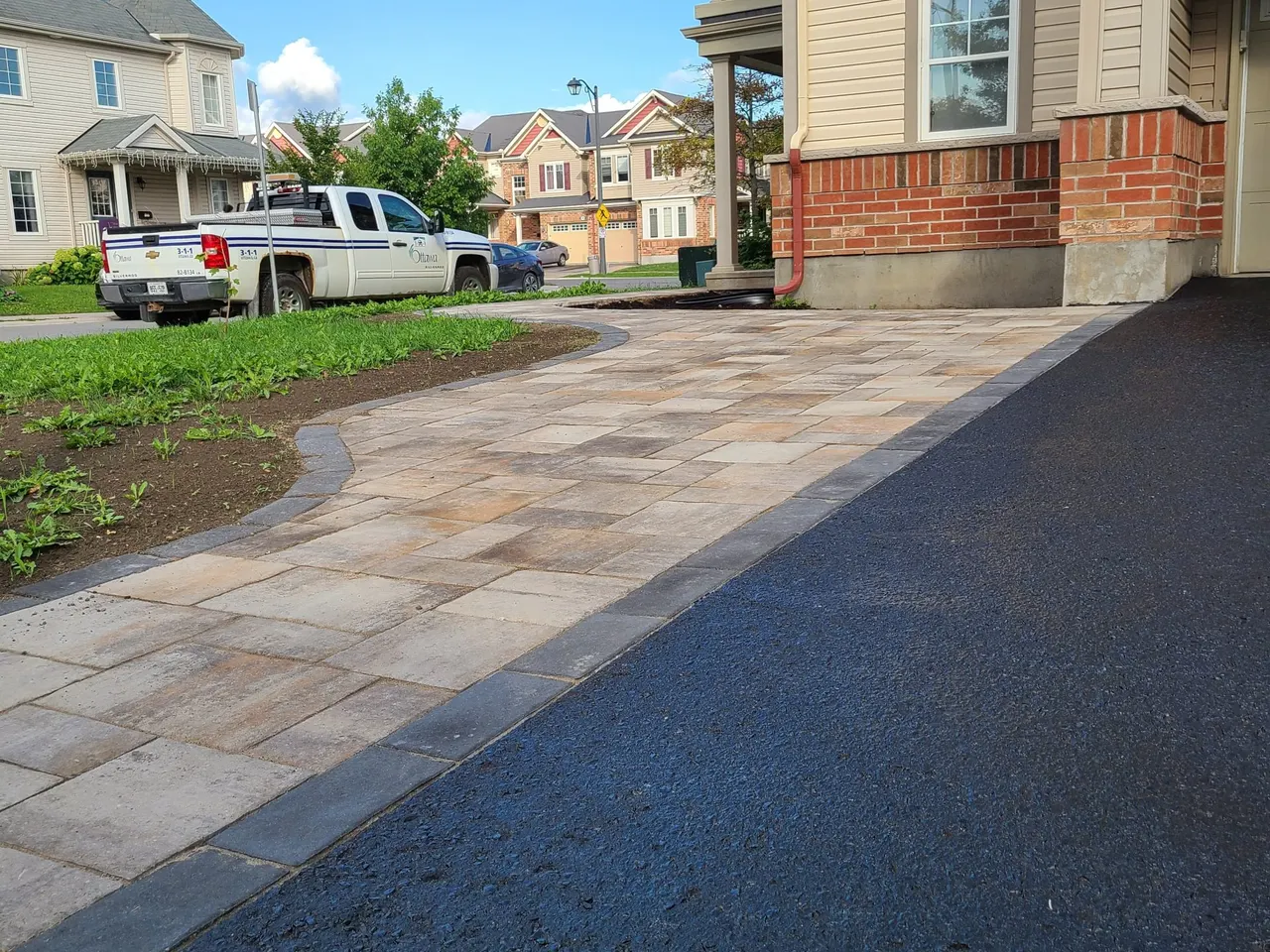
Hardscape is the built, non-living part of a yard: patios, walkways, front steps, driveways, retaining walls, pool surrounds, fire-pit pads and the base work that sits under all of them. Softscape is the planting, sod and soil. Our guide to hardscape versus softscape explains the split, and why the two should be planned together even when they are built in different seasons.
The reason the distinction matters when you hire is that hardscaping is mostly an earthworks job. The visible stone is the last day or two of the project. Everything before that is excavation, base, compaction and drainage, and that is the work you are really paying a hardscape contractor to get right.
Start with the City licence
Since March 1, 2026 the City of Ottawa has required hardscaping contractors to hold a municipal Hardscaping Contractor licence. The City’s Landscaping Education Guide sets out the scope: it applies to any business that installs or reconstructs driveways, parking areas, retaining walls, steps, patios, walkways or pathways on private property using hard landscaping materials.
Two things follow from that wording.
- Repairs count. Relaying a sunken walkway or rebuilding a failed retaining wall is reconstruction. The repair specialist needs the licence as much as the installer does.
- It is the first filter, not the last. A licence does not make a contractor good. But a business working without one in a licensed category has already shown you how it treats the rules, and that attitude tends to extend to base depths and locates too.
Ask to see it. We hold an active licence in good standing and show it without being asked.
Insurance and WSIB
Two documents, both easy for a legitimate contractor to produce:
- A certificate of liability insurance, current, in the business’s name. Hardscaping involves heavy equipment working near your foundation, your neighbour’s fence and buried services.
- A WSIB clearance certificate. It shows the business is registered with the Workplace Safety and Insurance Board and its account is in good standing, which matters when a crew is doing physical work on your property.
What a proper hardscape quote spells out
This is where quotes that look alike stop being alike. A one-page quote that reads “supply and install 400 sq ft interlock patio, $X” could describe a patio that lasts three winters or thirty. Here is what should be written down.
Excavation depth and disposal. How deep the crew will dig, and where the excavated soil goes. Trucking clay away costs money, which is exactly why some quotes quietly leave it on site.
Base material and depth, in inches. The Interlocking Concrete Pavement Institute’s minimum over well-drained soil is 4 inches of compacted aggregate for a patio and 6 for a residential driveway (ICPI Tech Spec No. 2). Most Ottawa lots are not well-drained soil. Our own minimum is 8 inches of compacted Granular A under a patio and 10 to 12 inches under a driveway. The reasoning is in our guide to patio base depth and the freeze-thaw cycle. Whatever the number is, it should be on paper.
Geotextile fabric. On clay it keeps the fine soil from migrating up into the stone base. On the newer subdivisions across the west end it is not optional.
Compaction. The base should be placed and compacted in lifts, not dumped to full depth and run over once.
The product, named. Manufacturer, line, colour and thickness. Driveway pavers are thicker than patio pavers for a reason. “Premium interlock” is not a specification.
Edge restraint and jointing. What holds the edges in, and whether the joints get polymeric sand.
Drainage and grading. Which way the surface slopes and where the water goes. The City’s guide is explicit that hard landscaping projects must not alter grading and drainage patterns, and that water cannot be directed onto a neighbouring property unless that is part of the approved plan. A quote that does not say where the water goes has not thought about it.
Locates. Provincial law requires underground utility locates through Ontario One Call before any digging, even with a hand shovel. The request is free and needs at least five business days for a single property. The quote should say who requests them.
Permits. Most patios and walkways do not need one. Some things do: the City’s guide says stairs and landings that provide access to a building can require a building permit, and a retaining wall more than 1 m high needs one when it is next to public property or next to an access to a building. Our permits guide for retaining walls and pool decks covers the common cases.
Warranty, in writing. How long, what it covers and what it excludes. Ours is a five-year workmanship warranty on hardscape work, on top of the manufacturer’s product warranty.
Schedule and payment. A start window, a rough duration and a payment schedule tied to progress.
Comparing three quotes
Ontario’s consumer guidance on renovations and repairs recommends getting at least three written estimates. The point is not to pick the lowest number. It is to lay the three side by side and find where they disagree.
Make a simple table with the lines above down the side and the three contractors across the top. Gaps show up fast. Typically:
- One quote lists base depth and one does not.
- One includes tear-out and disposal of the old surface, one assumes you will deal with it.
- One includes a drain or a small wall where the yard slopes, one prices a flat patio on a sloped yard and will discover the wall later.
- One names a paver line, one names a category.
When you find a gap, ask the contractor to fill it in writing. The answer, and how quickly it arrives, tells you a great deal. Our interlocking patio cost guide walks through a quote line by line, and for driveways, see the interlock driveway cost guide.
For context on price, Ottawa landscapers publish installed interlock prices in a broad band. Allen Landscaping puts economy work at $18 to $22 per square foot, mid-range at $25 to $35 and premium above $45, with most high-quality projects in the mid-to-high $30s. A quote well under that band is not a bargain. It is a different specification.
Deposits, estimates and your cancellation right
Ontario’s consumer rules apply to hardscaping just as they do to a kitchen. From the province’s guidance:
- Deposits. A down payment of no more than 10 per cent is recommended, and you should never pay the full amount before the work is complete.
- Estimates. The final price cannot be more than 10 per cent above the estimate unless you have agreed to a new price or new work. Get changes in writing before they are built.
- Cooling-off. A contract signed in your home and worth $50 or more can be cancelled within 10 days.
Our guide to choosing a renovation contractor covers those rules in more detail. They are written with interior work in mind, but every one of them applies to a patio.
Questions to ask on the site visit
The estimate visit is an interview in both directions. Six questions that separate contractors quickly:
- “Can I see your City licence?”
- “How deep is the base, and what is it?” The answer should be a number of inches and a material, not “whatever it needs”.
- “Will you dig a test hole?” Soil changes from one street to the next across Ottawa. On the new subdivisions it is compacted clay fill, in older neighbourhoods it may be decades of mixed fill, and near the Carp Hills you can meet rock. What that means for each suburb is in our guide to excavation and backfilling in Kanata, Stittsville and Nepean.
- “Where will the water go?”
- “Who will be on site?” The person selling the job and the crew building it are often different companies. At ALM, the owners who quote the job are on site during the build.
- “What happens if it settles?” Ask for the warranty terms in writing.
Red flags
- No base depth anywhere in the quote.
- A large cash payment up front, or a discount for paying in cash.
- Pressure to sign the same day.
- No mention of locates, or a start date sooner than locates can come back.
- A crew that turns up with the pavers and no excavator.
- Photos that are all finished-day shots, with nothing from the excavation or base stages.
- A contractor who does not know about the City licence, or tells you it does not apply to them.
Credentials that actually mean something
Manufacturer programs are worth asking about because they involve training on that manufacturer’s installation standards, and some carry extended product warranty coverage. We are TechoPro certified and a Techo-Bloc authorized contractor, a Permacon installer partner, and our crew is Unilock trained. Ask any contractor which programs they belong to and check with the manufacturer.
Hiring us
We build patios, walkways, front steps, driveways, retaining walls and pool surrounds across the west end and out to Lanark County. The full scope is on our hardscaping page, with local detail for Nepean, Kanata and Stittsville. If the project is a front walk or steps, our guide to stone walkways and front steps in Ottawa covers the Building Code and right-of-way rules that apply.
Book a free on-site estimate. We will dig a test hole, show you our licence and send a written, fixed-price scope with the base depth, the materials and the drainage spelled out, so you can compare it line by line with anyone else’s.
Published September 27, 2026 by ALM Construction & Landscaping. General information for Ottawa-area homeowners, not a substitute for the City's determination on your specific project.